

Rationale
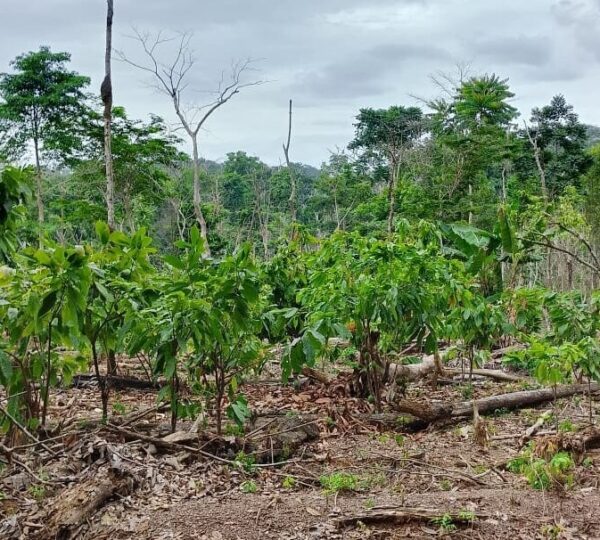
This investigation documents the environmental and socio-economic impacts of newly established cocoa farms on the Liberia-Côte d’Ivoire border (specifically the Taï – Grebo-Krahn forest which spans both countries). Independent Forest Monitoring (IFM) was undertaken by two field teams to address the following questions:
- Are cocoa farms continuing to drive deforestation, and is this affecting protected areas?
- Are reduced cocoa prices having an impact on deforestation?
- What does the post-harvest cocoa supply chain look like?
In Liberia, Save My Future Foundation’s (SAMFU) field team researched the north-west section of Grebo-Krahn National Park, the adjoining Konobo Community Forest (CF) and neighbouring farming communities.
In Côte d’Ivoire, L’Association Initiatives pour le Développement communautaire et la conservation de la Forêt (IDEF) field team worked in communities around Taï (Taï, Dahobly, Zaïpobli, Zagné), between Taï National Park and the Forêt classée de Cavally (protected forest), as well as at Cavally River crossing points around Tempo.
Fieldwork took place in May-July 2026, with interviewees including town and traditional chiefs, women’s and youth leaders, farmers, community members, and security personnel and Granex (a major cocoa trader operating in Liberia). All interviewees are anonymised for safety reasons.
 Why Taï Grebo matters
The transboundary landscape comprising Taï National Park (Côte d’Ivoire) and Grebo-Krahn National Park (Liberia) forms one of the largest remaining blocks of the Upper Guinean Forest, a globally-significant biodiversity hotspot. The landscape is increasingly threatened by cocoa cultivation.
Depleted soils and land scarcity in Côte d’Ivoire have driven a recent “cocoa rush” into Grand Gedeh, Liberia, and neighbouring counties, including protected areas where land-clearing and farming is illegal. This expansion has been accompanied by a substantial influx of migrant labourers, primarily from Côte d’Ivoire and Burkina Faso, who come to work in cocoa cultivation.
This expansion is important because cocoa supply chains will soon be under increased pressure. The European Union (EU) imports most of the world’s cocoa: in 2027, it will start enforcing its new Deforestation Regulation (EUDR), which bans cocoa associated with post 2020 deforestation and/or not meeting the laws of the producing country. The United Kingdom (UK) is also due to bring in similar legislation. Such developments will put Côte d’Ivoire and Liberia’s cocoa supply chains under renewed scrutiny. There is therefore a large economic incentive for governments, companies and smallholders to ensure that their cocoa cultivation respects human rights and is deforestation-free.
Findings
The investigation finds that cocoa expansion, migration, land governance and cross-border trade are parts of a single transnational system. An effective response will require coordinated action across both countries. Of particular note are the following:
- Cocoa-driven deforestation pressure in Taï – Grebo-Krahn remained high despite a fall in global cocoa prices at the end of 2025. Declining cocoa productivity in Côte d’Ivoire and limited livelihood opportunities in Liberia are sustaining the expansion of cocoa into forested areas, including national parks. The long-term trend is for deforestation in Côte d’Ivoire to shift to Liberia, potentially with equally devastating consequences.
- Expansion is being facilitated by recent but well-established cross-border migration networks. Evidence suggests a structured system linking labour recruitment, land allocation, farm establishment and cocoa marketing across national borders.
- The encroachment in Liberia is at a relatively early stage and can be stopped. But many people do not regard it as a problem: “no problem, there’s plenty of forest”, as one elder in Garleo, Liberia put it, continuing “if animals aren’t comfortable here they can go [to neighbouring counties]”.
- There are strong governance challenges. Forest land is allocated to people who sponsor migrants to travel, promising them work on the cocoa farms. This land is provided via weak verbal contracts, while unclear boundaries between community land and protected areas create opportunities for encroachment and disputes. Approaches focused solely on enforcement of forest, land and immigration laws are unlikely to succeed unless accompanied by stronger land governance, livelihood support and infrastructure development.
- There are important traceability challenges for governments, exporters and cocoa buyers seeking to demonstrate deforestation-free supply chains. Effective responses will require long-term cooperation between Liberia and Côte d’Ivoire, involving government agencies, local communities, civil society organisations and private-sector actors.
The report ends with recommendations for Côte d’Ivoire, Liberia, funders, NGOs, cocoa cooperatives, the UK and the EU.